How does “Net Shape” cold heading save cost and enhance precision?

Manufacturers today face the dual challenge of cutting costs while enhancing product performance. In this environment, production methods that combine efficiency with precision have become essential. One such method is net shape cold heading, a metal-forming process that not only reduces material waste but also delivers high accuracy, consistency, and strength. By shaping metal at room temperature, cold heading minimizes secondary machining, shortens lead times, and lowers production costs, all while meeting the demanding standards of modern industries.
What is Cold Heading?
Cold heading is a metal forming process in which a slug of wire or rod is forced into a die at room temperature. Unlike machining, where material is cut away, cold heading reshapes the metal without removing material. The result is a near-final part with exceptional structural integrity.
When pushed further to net shaped manufacturing, the part emerges from the die in its final form or with only minimal secondary operations required. This distinction is critical for manufacturers who want to reduce material waste and streamline production.
The Net Shape Advantage
“Net shape” refers to manufacturing parts so close to their finished geometry that little or no additional machining is required. Here’s why it matters:
- Material Savings – Since cold heading does not cut away material, scrap is virtually eliminated. This is especially valuable when working with high-cost alloys.
- Time Efficiency – Parts emerge nearly complete, reducing the number of machining steps.
- Precision – Tight tolerances and consistent part-to-part accuracy can be achieved.
- Strength – Cold working improves the mechanical properties of the metal by aligning its grain flow.
- Cost Reduction – Less waste, faster cycle times, and reduced labor translate directly to savings.
How does Net Shape Cold Heading Save Cost?
1. Minimizing Material Waste
Traditional machining involves cutting away large portions of raw material to achieve the desired shape. In contrast, cold heading uses nearly 100% of the starting slug. For expensive alloys like titanium or stainless steel, the cost savings are substantial.
For example, producing a fastener via machining may waste up to 60% of the raw bar. Net shape cold heading reduces this waste to less than 5%.
2. Lowering Labor and Machine Time
Machining complex geometries requires multiple setups, tool changes, and skilled labor. Net shape cold heading consolidates many of these steps into one forming operation. This means fewer hours on the shop floor, lower tool wear, and reduced energy consumption.
3. Faster Production Rates
Cold heading machines can produce hundreds of parts per minute, far surpassing the throughput of machining centers. This scalability makes it ideal for industries that need large volumes of identical parts, such as automotive, construction, and consumer electronics.
4. Reduced Secondary Operations
Because the part is already at or near its final shape, fewer finishing steps, such as grinding, drilling, or milling, are required. This lowers overall cycle time and reduces reliance on secondary processes that drive up costs.
Enhancing Precision Through Net Shape Cold Heading
1. Dimensional Accuracy
Modern cold heading technology achieves tolerances within thousandths of an inch. Consistency across high production runs means fewer rejected parts and higher reliability in end-use applications.
2. Superior Mechanical Properties
Unlike machining, which interrupts the grain structure of the metal, cold heading refines it. Grain flow follows the shape of the part, creating components that are not only precise but also stronger and more resistant to fatigue.
3. Complex Geometries Made Simple
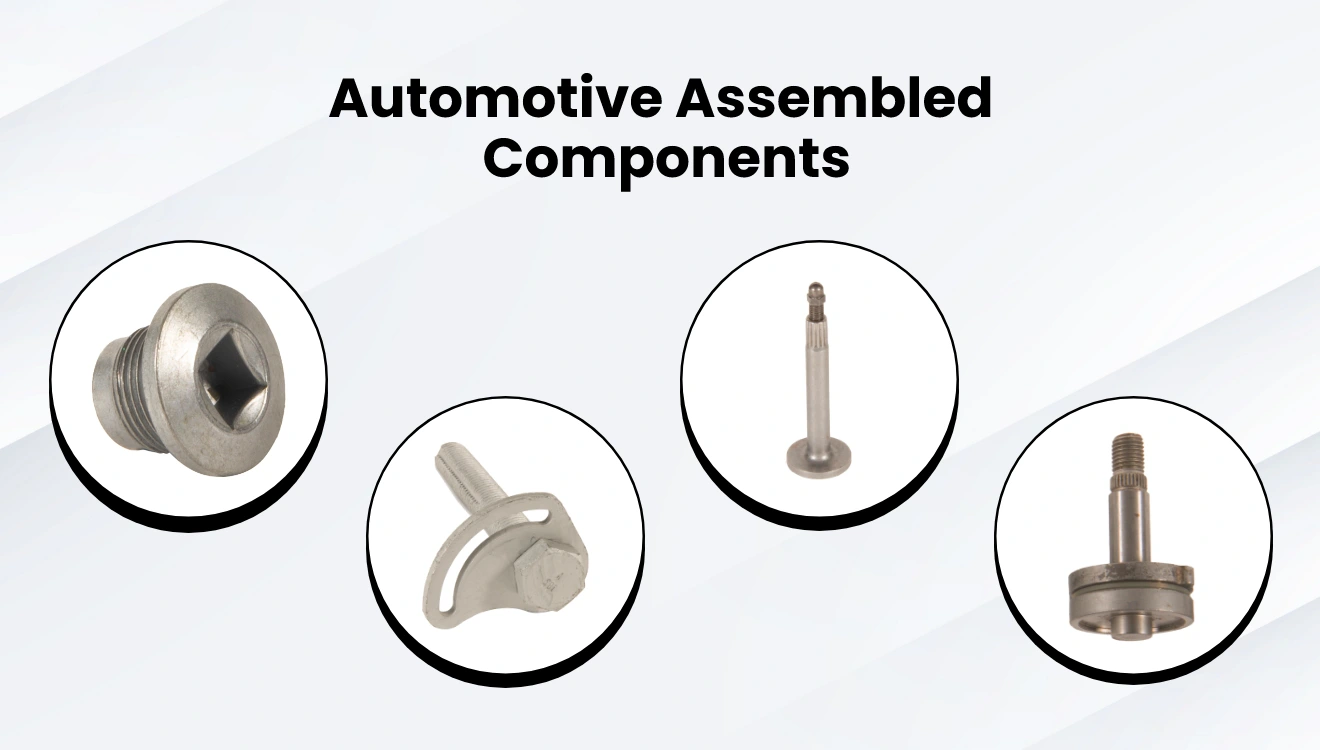
Advancements in tooling and multi-die progressive headers allow complex shapes such as flange bolts, knurled pins, and specialty fasteners to be produced with minimal machining.
4. Surface Finish Improvements
Parts formed through cold heading often have smoother surfaces compared to machined components. This reduces friction, enhances performance, and sometimes eliminates the need for additional finishing.
Real-World Applications
Automotive Industry
From engine bolts to suspension components, automakers rely on net shape cold heading for high-volume, high-strength parts. Precision ensures safety, while cost savings keep vehicles competitive in the marketplace.
Construction and Industrial Equipment
Heavy-duty bolts, rivets, and pins used in construction and industrial machinery benefit from the strength and dimensional accuracy of cold-headed parts.
Cold Heading vs. Machining: When does each make sense?
Cold Heading is best when:
- Production volumes are high. Tooling costs are amortized quickly.
- Material costs are significant. Scrap reduction provides direct savings.
- Geometry is simple or progressively formable. Fasteners, pins, studs, and bushings are prime candidates.
- Mechanical performance matters. Grain flow improves fatigue strength.
Machining still wins when:
- Ultra-tight tolerances are required. CNC machining can hold micron-level tolerances beyond the routine capability of cold heading.
- Complex geometries are involved. Deep cavities, cross-holes, or non-axisymmetric features may require cutting.
- Small-batch production. For low volumes, tooling costs for cold heading may not be justifiable.
Hybrid Approach: Near-Net-Shape + Finish Machining
Many manufacturers now adopt a hybrid strategy: form most of the part by cold heading to save cost, then finish-machine only the critical features that require extremely tight tolerances. This approach delivers both cost savings and precision where needed.
The Future of Net Shape Cold Heading
As industries continue to prioritize sustainability, net shape cold heading aligns perfectly with green manufacturing goals. By maximizing material utilization and reducing energy consumption, it lowers the environmental footprint of production.
Additionally, advances in computer-aided die design and high-performance materials are expanding the possibilities for what cold heading can achieve. More complex geometries, tighter tolerances, and higher-strength applications are now feasible.
Conclusion
Net shape cold heading is more than just a forming process; it’s a strategic advantage for manufacturers. By reducing material waste, minimizing machining, and delivering precise, high-strength components it helps companies save money while maintaining the highest quality standards.
For industries where cost efficiency and reliability are non-negotiable, net shape cold heading is not just the future of manufacturing, it’s the present.
With nearly 83 years of know-how passed from generation to generation, we comprehend the demands of the business. Vico Products’ progressive engineering capabilities and cutting-edge tooling designs lead to “net-shaped” fasteners. Vico Products’ assortment of the most accurate, productive and reliable progressive headers includes models made by world leaders such as Asahi Sunac, National Machinery, Sakamura, Nedschroef and Asahi Okuma. These multi-station forming machines with 4,5 and 6 forming dies provide us outstanding flexibility with high production abilities. With the means to cut off 15-32mm wire and with forming tonnages up to 550 tons, “Net Shape” designs of even the most highly tolerance precision is realized. Shortened lead times, due to warehoused steel, in house tool manufacturing and a reactive sub-supplier chain make us an appealing option. For more information, please request for a quote.